
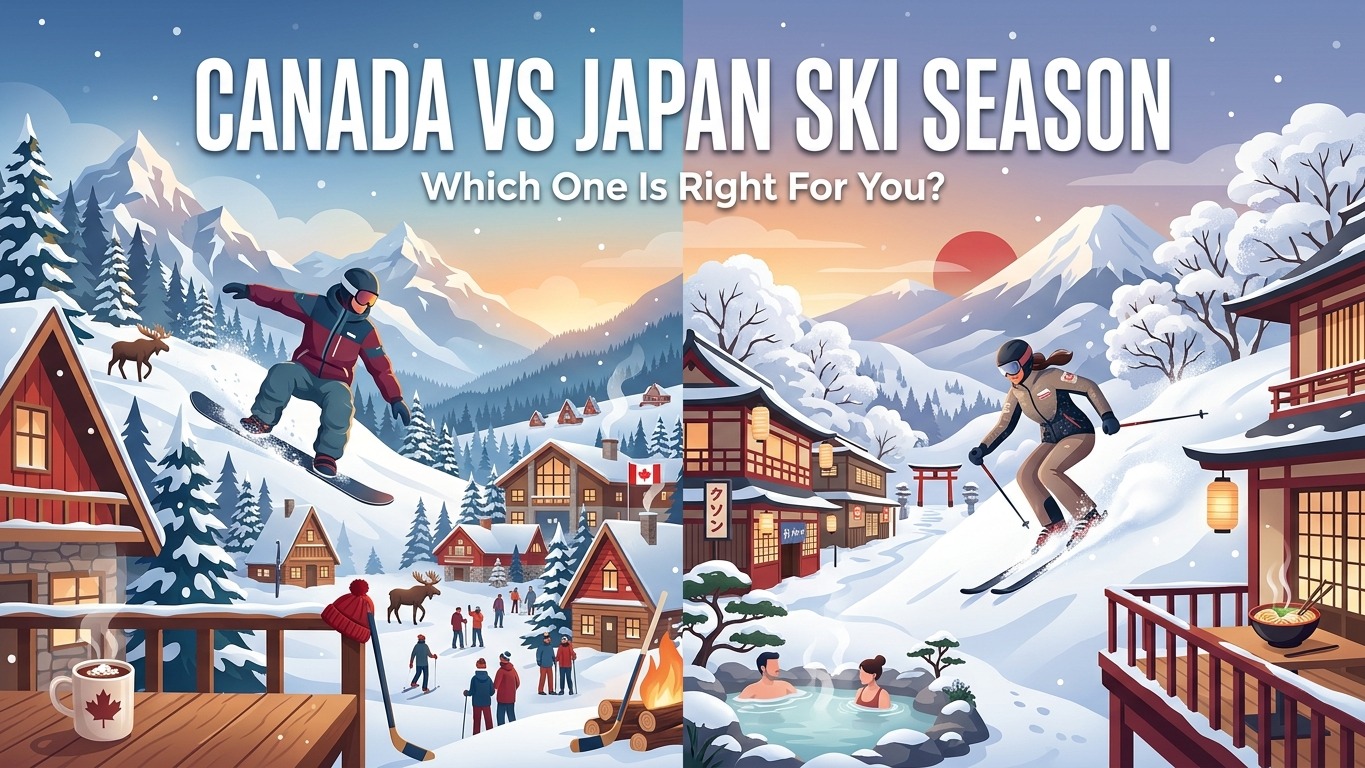
Canada vs Japan Ski Season: Which Is Better?
Mountain Connects
Planning a ski season and stuck between Canada and Japan?
Both are bucket-list destinations for seasonal workers, but the experience can be very different.
Canada is known for big mountain towns, lively après, long seasons and plenty of job variety. Japan is famous for deep powder, incredible food, unique culture and a ski season unlike almost anywhere else.
So which one should you choose?
The short answer: it depends on what you want from your season.
Canada vs Japan: which is better for a ski season?
Canada is a great option if you're looking for plenty of job opportunities, English-speaking workplaces, established seasonal communities and the classic ski-town lifestyle.
Japan could be the pick if you're chasing powder, want to experience a completely different culture and like the idea of spending a winter somewhere that feels truly unique.
Neither is automatically better — they're just very different seasons.
What is a ski season like in Canada?
Canada has some of the world's best-known ski destinations, particularly throughout British Columbia and Alberta.
Popular seasonal destinations include Whistler, Banff, Lake Louise, Big White, Revelstoke and Sun Peaks.
Depending on the resort and snowfall, the winter season generally gets going around November or December and runs through spring.
One of Canada's biggest advantages for seasonal workers is variety.
Jobs can be found with ski resorts, hotels, restaurants, bars, rental shops, tourism operators and local businesses throughout mountain towns.
That gives you plenty of options when deciding what you actually want your season to look like.
What is a ski season like in Japan?
Japan's ski season generally runs from December through to April, with January and February usually bringing the most consistent snowfall.
Popular destinations include Niseko, Hakuba, Nozawa Onsen, Furano and Rusutsu.
Japan is famous for its light, deep powder, particularly around Hokkaido and the Japanese Alps.
But a Japan season isn't just about the snow.
You could spend your winter living in a small mountain village, eating incredible food, visiting onsens and experiencing Japanese culture while riding some of the best powder of your life.
Where is it easier to find ski season work?
Canada often offers more variety when it comes to seasonal jobs.
Mountain towns have businesses hiring across hospitality, tourism, retail, accommodation and resort operations.
Common seasonal roles include:
- Lift operations
- Housekeeping
- Bars and restaurants
- Hotels
- Ski and snowboard rentals
- Retail
- Guest services
- Maintenance
- Ski and snowboard instruction
Japan also has a strong seasonal workforce, particularly in international destinations such as Niseko and Hakuba.
Hotels, restaurants, ski schools, rental businesses, tour operators and accommodation providers regularly rely on seasonal staff.
If having plenty of different job types to choose from is important to you, Canada may have the edge.
What visas do you need?
Your visa or work permit will depend on your citizenship, so this should be one of the first things you check.
For Canada, many international seasonal workers use the International Experience Canada (IEC) Working Holiday program.
IEC allows eligible people from participating countries and territories to live and work in Canada. Age limits, participation rules and permit lengths vary depending on your citizenship.
Japan also has Working Holiday arrangements with a number of countries and regions, with requirements varying by nationality.
Before choosing your destination, check whether you're eligible and how early you need to apply.
Don't book your whole season before understanding your visa situation.
Which has better snow?
If you're chasing powder, Japan is very hard to beat.
Cold winter weather combined with moisture from the Sea of Japan creates the conditions behind the country's famous powder, particularly in Hokkaido and areas of the Japanese Alps.
Canada offers a different kind of experience.
Depending on where you go, you'll find powder, alpine terrain, bowls, tree runs, groomers and huge areas to explore.
So a simple way to look at it:
Chasing powder? Japan.
Want huge terrain and plenty of variety? Canada.
Either way, you're going skiing.
What is the lifestyle like?
Canada delivers the classic ski-town lifestyle.
Think staff housing, après, house parties, busy resort villages and big communities of seasonal workers from around the world.
For English-speaking workers, settling in can also feel relatively straightforward.
Japan offers something completely different.
You're combining a ski season with Japanese food, language, culture, onsens and everyday life in another country.
The social scene depends on where you go. International resorts such as Niseko can be lively, while smaller Japanese mountain towns may offer a quieter and more traditional experience.
If you want the classic season experience, Canada is hard to go past.
If you want your ski season to double as a cultural adventure, Japan has a lot going for it.
What about accommodation?
Accommodation can be one of the biggest challenges in both destinations.
In Canada, some resorts and employers offer staff accommodation, but housing in popular mountain towns can be competitive.
If housing isn't included with your job, start looking early.
Japan is similar. Accommodation in popular ski areas can fill quickly, while some employers offer staff housing as part of their employment package.
When comparing jobs, don't only compare wages.
A slightly lower-paying job with affordable staff accommodation and a season pass could leave you much better off than a higher-paying role where you have to find expensive housing yourself.
Look at the whole package.
Which is more expensive?
There's no simple winner here because costs vary massively between resorts.
Major Canadian mountain towns can be expensive, particularly when it comes to rent, groceries and going out.
Popular international resorts in Japan can also be expensive, especially during peak winter.
Whichever destination you choose, budget for:
- Accommodation
- Food
- Transport
- Phone
- Insurance
- Ski or snowboard gear
- Flights
- Visa costs
- Social life
- Emergency savings
And leave yourself some room to actually enjoy the season.
You don't want to move halfway around the world and spend the entire winter saying no because you've blown your budget in week two.
Why choose Canada for a ski season?
Canada could suit you if you're looking for:
- Plenty of seasonal job options
- English-speaking workplaces
- Big mountain towns
- A lively après scene
- Large international seasonal communities
- Varied ski and snowboard terrain
- The classic ski-season lifestyle
It can be an especially approachable option for your first international season.
Why choose Japan for a ski season?
Japan could suit you if you're looking for:
- World-famous powder
- Japanese culture
- Incredible food
- Onsens
- A different kind of mountain lifestyle
- An international adventure
- The opportunity to travel around Japan
- A winter that feels completely different from home
For many seasonal workers, Japan isn't just about getting days on the mountain.
Living there is a huge part of the experience.
Canada or Japan for your first ski season?
If it's your first season and you're a little nervous about moving overseas, Canada may feel like the easier introduction.
The English-speaking environment, established seasonal communities and wide range of jobs can make getting settled simpler.
Japan can still be an incredible first season if you're excited about stepping further outside your comfort zone.
There isn't a wrong answer.
Think about what you want to get out of the experience rather than simply asking which country is "better."
Canada vs Japan at a glance
Choose Canada if you want:
- More job variety
- Bigger resort towns
- Lively après
- Large seasonal communities
- English-speaking workplaces
- Huge and varied terrain
Choose Japan if you want:
- Deep powder
- Japanese culture
- Incredible food
- Onsens
- A bigger cultural adventure
- A truly different ski season experience
Final verdict
Canada and Japan are both incredible places to spend a ski season.
Canada gives you the classic mountain-town experience — big resorts, plenty of seasonal jobs, lively communities and a winter built around mountain life.
Japan gives you something different — legendary powder, amazing food, unique mountain towns and the opportunity to experience another culture while spending your winter on snow.
Still can't decide?
Start by looking at the jobs, resorts and accommodation available in each destination. Sometimes the right opportunity makes the decision for you.
Browse seasonal jobs in Canada and Japan on Mountain Connects:
https://www.mountainconnects.com/jobs
Whichever way you go, you're setting yourself up for a pretty good winter.